Gurgaon Metro Expansion: Which Property Markets Could Benefit Most?
Urban transit infrastructure has long been the single most powerful driver of real estate value across the National Capital Region (NCR). In Millennium City, where rapid corporate expansion has historically outpaced municipal road networks, daily commuting efficiency dictates residential demand, rental yields, and capital growth. The announcement and active implementation of the Gurgaon Metro Expansion specifically the approved 28.5-kilometer Gurugram Metro Rail Limited (GMRL) ring loop marks a monumental structural shift in the city’s spatial economics. Bypassing legacy traffic bottlenecks and connecting long-underserved pockets of Old Gurgaon to prime commercial centers like DLF Cyber City and Millennium City Centre, this infrastructure expansion is redrawing the real estate investment map. Evaluating opportunities through Ireo New Project Gurgaon illustrates how master-planned residential developments situated along active and proposed transit corridors offer buyers an ideal mix of daily convenience, modern urban design, and long-term equity multiplication.
In this comprehensive, data-backed guide, we analyze the micro-markets, sectors, and commercial belts poised to gain the most from this mass rapid transit transformation. From the traditional residential sectors of Old Gurgaon to the emerging high-rise corridors along Southern Peripheral Road (SPR), Golf Course Extension Road, and the Dwarka Expressway, this evaluation breaks down station alignments, price appreciation forecasts, rental market shifts, and actionable investor frameworks.
Strategic Impact of Gurgaon Metro Expansion on Regional Real Estate
The expansion of Gurgaon’s mass rapid transit network addresses a decade-old structural divide: the disconnection between the densely populated, traditional layouts of Old Gurgaon and the corporate financial hubs along Golf Course Road, Cyber City, and NH-48. By creating a unified 28.5 km elevated loop, GMRL will seamlessly integrate DMRC’s Yellow Line and the Gurgaon Rapid Metro into a single continuous loop.
Unpacking the GMRL 28.5 km Metro Ring Loop Architecture
Understanding the physical route alignment is essential for identifying property hotspots before market values fully adjust. The metro loop starts at Millennium City Centre (formerly HUDA City Centre) and moves through major commercial, residential, and industrial nodes.
Sector Alignment and Key Transit Interchanges
The approved route passes through key municipal hubs:
- Central Link: Millennium City Centre to Sector 45, Cyber Park, and Subhash Chowk.
- Arterial Bypass: Subhash Chowk along Southern Peripheral Road feeder routes to Hero Honda Chowk on NH-48.
- Old Gurgaon Spine: Hero Honda Chowk through Sector 10, Sector 37 (Industrial Area), Sector 10A, Sector 4, Sector 7, and Railway Station Road.
- Northern Connector: Sector 23, Palam Vihar, and Maruti Udyog, culminating in a direct interchange loop at DLF Cyber City.
- Dwarka Expressway Spur: A dedicated spur line branching from Palam Vihar toward Sector 101/102 to connect with the Dwarka Expressway corridor.
Connecting Old Gurgaon to Cyber City and Millennium City Centre
Historically, residents in Sectors 4, 7, 9, and Palam Vihar faced 45 to 60-minute road commutes to reach office parks in Cyber City or Golf Course Road during peak hours. The new loop cuts transit times to under 20 minutes via elevated rail, instantly boosting housing demand across these established residential belts.
Top Property Markets Set for Maximum Capital Appreciation
The roll-out of the metro ring loop creates clear investment winners across distinct real estate micro-markets. Below is a detailed breakdown of the sectors positioned to gain the most equity growth.
Old Gurgaon Hubs: Sectors 4, 7, 9, 10, and Palam Vihar
Old Gurgaon features well-established residential layouts, plotted developments, independent builder floors, and low-density government housing schemes. However, poor mass transit access previously restricted capital value growth compared to eastern Gurgaon.
- Connectivity Surge: Direct metro access at Sector 4, Sector 7, and Palam Vihar removes the dependence on private auto-rickshaws and congested arterial roads.
- Real Estate Outlook: Independent builder floors and redevelopment projects in these sectors are projected to experience capital value increases of 25% to 35% over the construction and operational phases.
- Target Buyer Profile: Mid-level corporate professionals, government employees, and local business families seeking central location advantages at accessible entry prices.
Arterial Interchanges: Hero Honda Chowk & Subhash Chowk Belts
Hero Honda Chowk and Subhash Chowk serve as two of Gurgaon’s busiest traffic junctions, linking NH-48, Sohna Road, and Southern Peripheral Road (SPR).
- Connectivity Surge: Transforming these road junctions into elevated multi-modal metro interchanges allows commuters to switch effortlessly between regional highway networks and suburban rail systems.
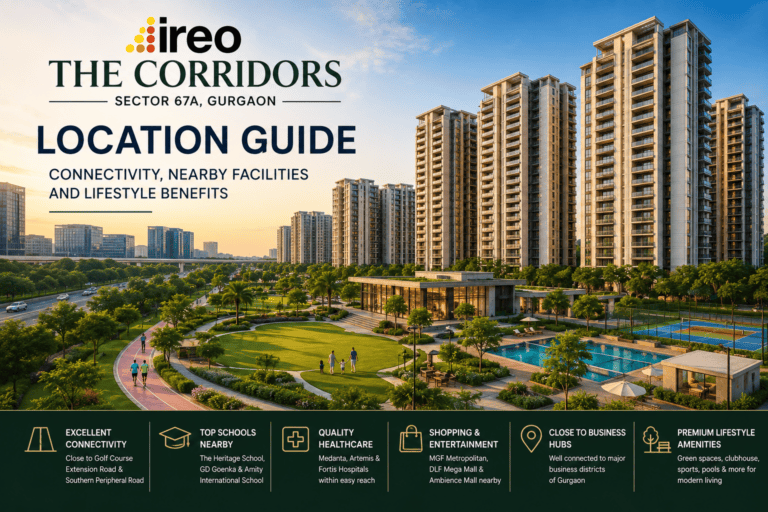
- Township Ecosystems: Integrated developments situated nearby benefit greatly from this upgraded connectivity. For instance, master-planned townships like Ireo Corridors in Sector 67 demonstrate how living close to SPR transit arteries gives residents rapid access to both corporate office belts and self-contained community facilities.
- Real Estate Outlook: Rental yields in Sectors 33, 34, 47, 48, and 70 are projected to expand from current averages of 3.8% to over 4.8% as tenant demand rises.
Southern Peripheral Road (SPR) & Sector 65-68 Belt
Southern Peripheral Road is rapidly developing into a major commercial and residential boulevard, functioning as a natural extension of Golf Course Road.
- Connectivity Surge: The metro expansion along Subhash Chowk directly serves the SPR precinct, connecting residents to corporate hubs without subjecting them to local highway traffic.
- Luxury High-Rise Appeal: Architectural landmarks such as IREO Victory Valley in Sector 67 illustrate how high-rise developments equipped with multi-tiered central green spaces, sky-deck amenities, and DGU acoustic glass benefit from proximity to high-speed transit corridors while preserving peaceful, quiet living environments inside.
- Real Estate Outlook: Capital value appreciation along SPR is forecasted at 18% to 28% over the next 36 months, driven by white-collar corporate professionals seeking modern gated communities near transit hubs.
Golf Course Extension Road Belt
Golf Course Extension Road (GCER) remains the primary corridor for luxury residential developments in Millennium City.
- Connectivity Surge: While the existing Rapid Metro line terminates at Sector 55-56, proposed feeder loops and secondary station links will connect GCER seamlessly to the broader GMRL ring network.
- Established Luxury Standards: Established gated communities like IREO Grand Arch in Sector 58 demonstrate how prime location placement near major metro and highway junctions preserves property values, keeping resale demand strong among senior corporate executives.
- Serviced Accommodations: The influx of international business travelers and corporate consultants along transit corridors boosts demand for managed luxury living. Serviced developments like Ireo Ascott Gurgaon highlight how hospitality-led residential products near major transit hubs achieve higher occupancy rates and premium rental returns.
Dwarka Expressway & New Gurgaon Synergy
The inclusion of a 1.85 km metro spur branching from Palam Vihar toward the Dwarka Expressway ensures that New Gurgaon (Sectors 81 to 115) integrates directly into the main city loop.
- Connectivity Surge: Residents in Sectors 102, 103, and 106 will gain a direct rail link to IGI Airport, Cyber City, and South Delhi.
- Real Estate Outlook: Property demand in Dwarka Expressway sectors is expected to remain high, supported by the combination of a 16-lane operational expressway and dedicated mass rapid transit lines.
Comprehensive Micro-Market Comparison Matrix
To help investors and homebuyers compare prospective property markets benefiting from the Gurgaon Metro Expansion, the matrix below details key pricing, rental yield, and growth metrics:
| Micro-Market / Sector | Nearest Metro Station (GMRL) | Current Avg. Rate (₹/sq.ft.) | Projected Appreciation (3-Yr) | Expected Rental Yield | Primary Property Type |
| Sectors 4, 7 & 9 | Sector 4 / Sector 7 Station | ₹8,500 – ₹14,000 | 28% – 35% | 3.5% – 4.2% | Builder Floors, Plotted |
| Palam Vihar & Sec 23 | Palam Vihar Station | ₹9,500 – ₹15,500 | 25% – 32% | 3.8% – 4.4% | Independent Floors, Villas |
| Hero Honda Chowk Belt | Hero Honda Chowk Interchange | ₹10,000 – ₹16,500 | 22% – 28% | 4.2% – 4.8% | Mid-Rise Flats, Commercial |
| Subhash Chowk / Sec 48 | Subhash Chowk Station | ₹12,000 – ₹18,500 | 20% – 26% | 4.1% – 4.7% | Gated Apartments, High Streets |
| SPR / Sector 67 & 68 | SPR Feeder Link | ₹12,500 – ₹19,000 | 18% – 25% | 4.3% – 5.1% | Luxury High-Rises, Townships |
| GCER / Sector 58 & 59 | Sector 55-56 Interchange | ₹16,500 – ₹27,000 | 15% – 22% | 4.5% – 5.4% | Ultra-Luxury Condos, Serviced |
Investment Dynamics: Capital Appreciation, Rental Yields, and Commercial Synergy
The financial mechanics of Transit-Oriented Development (TOD) follow predictable patterns across top global cities. When a mass transit line is announced and built, real estate markets undergo three distinct growth phases:
1. Rental Yield Surges in Transit-Oriented Belts
Tenant demand in Gurgaon is closely tied to commute times. Corporate employees working in Cyber City, Horizon Center, or Udyog Vihar pay higher rents for homes located within a 10-minute walk or short feeder ride to a metro station.
- Vacancy Rate Reduction: Properties within 1 kilometer of metro stations maintain vacancy rates below 3%, compared to 8% to 12% for off-grid properties.
- Premium Rental Returns: Landlords can charge an 18% to 25% rental premium for apartments near active metro stations.
2. Commercial Real Estate Alignment and Walk-to-Work Ecosystems
The metro loop encourages decentralized commercial growth. High-street retail centers, co-working facilities, and neighborhood office parks will develop naturally around metro stations like Subhash Chowk, Hero Honda Chowk, and Palam Vihar, creating walk-to-work ecosystems that further boost nearby residential values.
Market Statistics, Historical Trends, and Research Data
Institutional real estate studies highlight the long-term impact of rail transit expansion on property values:
- DMRC Yellow Line Historical Data: Following the completion of the DMRC Yellow Line extension to Millennium City Centre in 2010, residential properties within a 1.5 km radius experienced a 65% capital value increase over 36 months, outperforming non-metro sectors by more than double.
- Tenant Preference Shift: Over 72% of corporate renters surveyed in Gurgaon list “proximity to metro station (< 15 mins)” as one of their top two criteria when choosing a home.
- RERA-Backed Infrastructure Confidence: With GMRL executing the project under strict municipal oversight and state funding, buyer confidence in off-plan and under-construction projects near proposed stations has risen sharply.
Future Outlook & Long-Term Infrastructure Integration
The Gurgaon Metro Expansion does not exist in isolation; it integrates into a wider regional transit web designed to connect the entire NCR:
- Delhi-Gurgaon-Alwar RRTS Interchanges: The Regional Rapid Transit System (RRTS) will feature strategic interchange hubs at Cyber City and Rajiv Chowk, allowing residents along the GMRL loop to travel to Delhi, Faridabad, or Alwar at speeds up to 160 km/h.
- HSIIDC Global City Synergy: Spanning over 1,000 acres along CPR and Dwarka Expressway, the Global City development will function as an international financial center. The GMRL spur ensures that workforce housing across Old and New Gurgaon connects directly to this high-density job market.
Investor Due Diligence Framework for Metro-Adjacent Properties
While metro proximity drives property growth, buyers must evaluate key structural, legal, and location factors before investing:
- Acoustic Insulation: Properties built directly adjacent to elevated tracks can experience noise and vibration. Verify that the developer installs double-glazed windows (DGU glass) and maintains adequate structural setbacks.
- Optimal Distance Window: The sweet spot for residential property value is between 500 meters and 1.5 kilometers from a station—close enough for an easy walk or feeder trip, but far enough to avoid station congestion and street noise.
- The Expansion Plan: The GMRL 28.5 km elevated metro ring loop features 27 stations, bridging the transit gap between Old Gurgaon, Cyber City, and Southern Peripheral Road.
- Top Beneficiary Markets: Old Gurgaon (Sectors 4, 7, 9, 10, Palam Vihar) will see significant equity gains (25% to 35%), while SPR and GCER corridors benefit from higher rental yields and luxury market growth.
- Interchange Hotspots: Hero Honda Chowk, Subhash Chowk, and Palam Vihar will develop into high-density commercial and transit hubs.
- Financial Advantages: Metro-adjacent properties yield 18% to 25% higher rents and maintain lower vacancy rates than off-grid properties.
Frequently Asked Questions
What is the Gurgaon Metro Expansion project?
The Gurgaon Metro Expansion is an approved 28.5 km elevated metro ring loop built by Gurugram Metro Rail Limited (GMRL). It features 27 stations connecting Millennium City Centre to Cyber City via Old Gurgaon, Hero Honda Chowk, and Subhash Chowk.
Which sectors in Old Gurgaon will benefit most from the metro expansion?
Sectors 4, 7, 9, 10, 10A, 23, and Palam Vihar will benefit significantly, as direct metro access cuts commute times to Cyber City and Golf Course Road from 50 minutes down to under 20 minutes.
How does the GMRL Metro loop connect to the existing DMRC Yellow Line?
The new GMRL loop creates direct interchange nodes at Millennium City Centre and Cyber City, connecting seamlessly with DMRC’s Yellow Line and the Gurgaon Rapid Metro network.
Will property prices rise along Southern Peripheral Road (SPR) due to the metro expansion?
Yes, property prices along SPR (Sectors 67, 68, 70, 70A) are projected to appreciate by 18% to 25% as the metro loop at Subhash Chowk provides fast transit to corporate office hubs.
How much capital appreciation can buyers expect near upcoming metro stations?
Historically, properties situated within 1.5 km of new metro stations in Gurgaon experience capital value growth of 20% to 35% between the construction phase and full operational status.
Is buying property near Hero Honda Chowk a good long-term investment?
Yes, converting Hero Honda Chowk into a major multi-modal metro interchange makes surrounding sectors (33, 34, 84, 85) prime locations for commercial retail expansion and residential rental demand.
How does living near a metro station impact rental yields in Gurgaon?
Residential properties located near metro stations achieve higher rental yields (4.2% to 5.4%) compared to off-grid properties (2.8% to 3.5%), driven by strong demand from corporate professionals.
Does the Gurgaon Metro Expansion connect to the Dwarka Expressway?
Yes, the GMRL master plan includes a dedicated 1.85 km spur line branching from Palam Vihar toward Sector 101/102 along the Dwarka Expressway corridor.
What is the optimal distance to buy a flat near a proposed metro station?
The ideal distance for a residential flat is between 500 meters and 1.5 kilometers from a metro station. This offers convenient walking or feeder access while avoiding immediate track noise and station congestion.
How will the metro loop affect traffic congestion on NH-48 and Sohna Road?
By providing a fast, reliable rail alternative for daily commuters traveling between Old Gurgaon, SPR, and Cyber City, the metro loop is expected to significantly reduce private vehicular traffic on NH-48 and Sohna Road.
Are builder floors in Old Gurgaon better investments than high-rise flats near metro corridors?
Builder floors in Old Gurgaon offer lower entry price points and higher immediate capital appreciation potential (25% to 35%). However, luxury high-rise gated societies along SPR and GCER offer superior lifestyle amenities, better security, and higher long-term rental stability.
What noise mitigation features should I look for in metro-adjacent apartments?
Look for projects engineered with double-glazed glass (DGU windows), acoustic balcony doors, thick exterior masonry, and structural setbacks exceeding 100 meters from elevated track pillars.
When is the GMRL 28.5 km Metro Ring Loop expected to become operational?
Phased construction is underway, with core operational links targeted for completion within 3 to 4 years under state transit timelines.
How does the metro expansion link to the proposed HSIIDC Global City?
The metro loop connects directly to Central Peripheral Road (CPR) feeder networks, giving residents easy transit access to the 1,000+ acre Global City business district in Sectors 36B and 37B.
Why do NRIs prefer investing in transit-oriented luxury properties in Gurgaon?
NRIs favor transit-oriented luxury developments because they offer reliable rental demand, professional property management options, quick access to IGI Airport, and consistent long-term capital growth.
Final Thoughts
The Gurgaon Metro Expansion represents a major shift in Millennium City’s real estate market. By bridging the transit gap between Old Gurgaon and modern corporate hubs, the 28.5 km GMRL ring loop unlocks real estate value across previously underserved sectors. Whether you invest in the redeveloping sectors of Old Gurgaon, the arterial interchanges at Hero Honda Chowk and Subhash Chowk, or the master-planned luxury developments along SPR and Golf Course Extension Road, securing property near this expanding transit loop guarantees long-term equity growth, strong rental demand, and everyday urban convenience.