Top Emerging Sectors in Gurgaon That Could See Strong Property Demand
Gurgaon’s real estate landscape is undergoing a monumental shift driven by rapid infrastructure development, mega transit corridors, and an influx of multinational corporations. As central hubs like Golf Course Road and MG Road reach peak saturation and premium pricing thresholds, smart investors and homebuyers are directing their focus toward emerging sectors in Gurgaon. Identifying these high-potential micro-markets early allows capital allocators to capture maximum price appreciation, superior rental yields, and modern urban planning before market consolidation occurs. Evaluating strategic developments such as Ireo New Project Gurgaon demonstrates how master-planned residential communities in high-growth corridors are reshaping the benchmark for contemporary living and investment performance across the National Capital Region (NCR).
In this extensive, data-backed guide, we dive deep into the top emerging sectors across Gurgaon that are projected to experience exponential housing and commercial demand over the next decade. From the seamless connectivity of the Dwarka Expressway to the infrastructure-led expansion of Southern Peripheral Road (SPR), Golf Course Extension Road, and New Gurgaon, this analysis equips you with actionable insights, pricing trends, infrastructure timelines, and step-by-step evaluation frameworks.
Top Emerging Sectors in Gurgaon Transforming Real Estate Investments
The transformation of Millennium City from an industrial town into an economic powerhouse relies heavily on Transit-Oriented Development (TOD) and infrastructure corridors. The emergence of mega projects including the operational 16-lane Dwarka Expressway, the Central Peripheral Road (CPR), Sohna Elevated Road (NH-248A), and the approved Gurugram Metro Rail Limited (GMRL) loop—has redrawn the real estate roadmap.
Emerging sectors are no longer peripheral outposts; they are self-sustaining urban ecosystems equipped with grade-A commercial office space, healthcare facilities, international schools, and expansive open green buffers. Understanding the specific micro-market drivers across these growth belts enables buyers to match their risk profile with high-performing real estate assets.
Dwarka Expressway Corridor: The Northern Growth Engine
The completion of the 29-kilometer Dwarka Expressway has opened up a seamless arterial link between Delhi (Indira Gandhi International Airport and Dwarka) and Gurgaon. Sectors situated directly along this expressway represent the most vibrant growth zone for high-end luxury housing and commercial real estate.
Sector 111 and 113 (Smart City Delhi Border)
Sectors 111 and 113 are strategically positioned right at the Delhi-Gurgaon border, making them the closest Gurgaon sectors to Delhi’s Diplomatic Enclave II and Yashobhoomi (India International Convention & Expo Centre).
- Average Capital Rates: ₹18,000 to ₹26,000 per sq. ft.
- Rental Yield: 3.8% to 4.5%
- Key Growth Drivers: Proximity to IGI Airport (10 to 15-minute drive), zero-commute access to West Delhi, and low-density luxury high-rise developments.
Sector 102 and 106 (Mid-Expressway Luxury Hubs)
Sectors 102 and 106 feature planned township infrastructure with broad sector roads and dedicated green belts. These sectors are attracting top-tier national developers offering luxury 3 BHK and 4 BHK residences integrated with modern amenities.
- Average Capital Rates: ₹13,500 to ₹21,000 per sq. ft.
- Rental Yield: 4.0% to 4.8%
- Key Growth Drivers: Direct access to the 16-lane expressway, planned AIIMS Jhajjar feeder access, and upcoming commercial retail hubs.
Southern Peripheral Road (SPR) & Sector 67/68 Corridor
Southern Peripheral Road (SPR) connects Golf Course Extension Road to National Highway 48 (NH-48) at Hero Honda Chowk. With major road-widening projects, flyover completions, and proposed metro lines running parallel to SPR, sectors along this belt are rapidly appreciating.
Sector 67 and 68 (Self-Sustained Master-Planned Precincts)
Sector 67 and 68 represent the evolution of modern township planning in Gurgaon. These sectors offer a harmonious blend of high-density luxury high-rises, commercial office complexes, and integrated retail high streets.
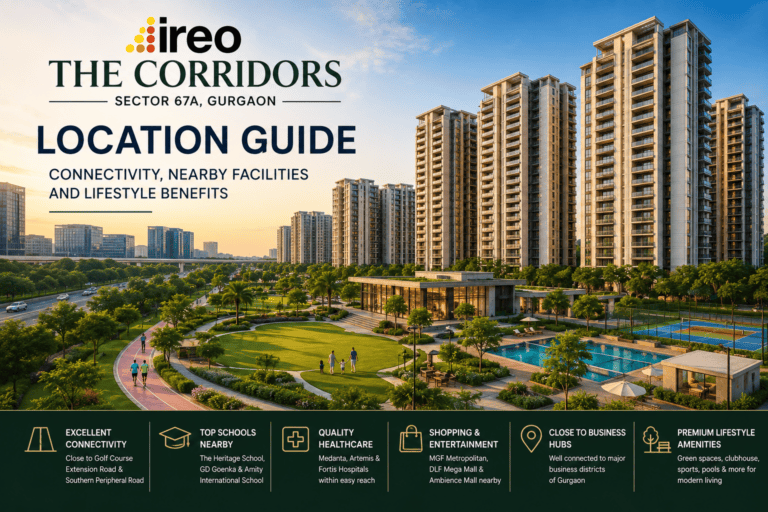
Investments in master-planned communities like Ireo Corridors in Sector 67 illustrate how large-scale residential projects with internal sports facilities, primary schools, and vast green spaces provide end-users with complete urban self-sufficiency.
- Average Capital Rates: ₹12,000 to ₹18,500 per sq. ft.
- Rental Yield: 4.2% to 5.1%
- Key Growth Drivers: Direct entrance to Sohna Elevated Road, proximity to Golf Course Road corporate parks, and upcoming GMRL Metro stations.
Sector 70 and 70A (High-Growth Residential Pocket)
Sectors 70 and 70A are situated adjacent to the SPR alignment, offering quick connectivity to both Golf Course Extension Road and NH-48. This area has emerged as a favored choice for corporate executives working in Cyber City and Sohna Road office hubs.
- Average Capital Rates: ₹11,500 to ₹17,000 per sq. ft.
- Rental Yield: 4.1% to 4.9%
- Key Growth Drivers: Underground utility corridors, well-connected feeder roads, and high demand from white-collar tenant populations.
Golf Course Extension Road Expansion: Sectors 58, 59, 61, & 62
Golf Course Extension Road is already established as a luxury market, but its outer expansion sectors—specifically 58, 59, 61, and 62—are now entering an aggressive capital growth phase.
Sector 58 and 59 (Luxury Intersections)
Sectors 58 and 59 sit at the crucial junction connecting Golf Course Road, Golf Course Extension Road, and the Gurgaon-Faridabad Road. This prime positioning makes them highly coveted for ultra-luxury residential projects and high-end serviced apartments.
Projects like Ireo Ascott Gurgaon cater directly to global corporate travelers and expatriate executives seeking fully serviced luxury accommodations near core financial centers.
- Average Capital Rates: ₹16,500 to ₹27,000 per sq. ft.
- Rental Yield: 4.5% to 5.4%
- Key Growth Drivers: Immediate connectivity to Rapid Metro Sector 55-56 terminal, low-density zoning, and sweeping views of the Aravalli hills.
Sector 61 and 62 (Established Luxury Standards)
Sector 61 and 62 are home to iconic architectural marvels that redefined skyline design in Gurgaon. Landmark communities such as IREO Grand Arch in Sector 58 and IREO Victory Valley in Sector 67 demonstrate how tall vertical living paired with multi-tiered clubhouses and double-glazed curtain walls set high benchmarks for capital value retention across the region.
- Average Capital Rates: ₹15,500 to ₹25,000 per sq. ft.
- Rental Yield: 3.9% to 4.7%
- Key Growth Drivers: Operational commercial centers (WorldMark, M3M Urbana), fine dining corridors, and wide 60-meter sector roads.
New Gurgaon & Central Peripheral Road (CPR) Belt: Sectors 84 to 95
New Gurgaon comprising sectors located along the Central Peripheral Road (CPR), KMP Expressway, and NH-48—has transitioned from an emerging affordable market into a thriving, mid-to-high-end residential destination.
Sector 88 (The Commercial Central Business District)
Sector 88 is designated under the Gurgaon Master Plan as a massive commercial hub. Once fully operational, Sector 88 will serve as New Gurgaon’s equivalent to Cyber City, driving immense housing demand in surrounding residential sectors like 84, 85, 89, and 90.
- Average Capital Rates: ₹10,500 to ₹16,000 per sq. ft.
- Rental Yield: 4.3% to 5.2%
- Key Growth Drivers: Strategic position at the junction of Dwarka Expressway and CPR, planned commercial towers, and multi-modal transit terminals.
Sectors 84, 85, and 89 (Immediate CPR Living)
These sectors benefit directly from the Clover Leaf Interchange, which seamlessly integrates Dwarka Expressway, CPR, SPR, and NH-48 into a single signal-free traffic junction. Commuting to Cyber City or IGI Airport takes under 25 minutes.
- Average Capital Rates: ₹8,500 to ₹13,500 per sq. ft.
- Rental Yield: 4.0% to 4.8%
- Key Growth Drivers: Excellent signal-free connectivity, mature social infrastructure (DPS, MatriKiran, Care Hospitals), and high tenant demand from nearby industrial hubs like IMT Manesar.
Comprehensive Micro-Market Comparison Matrix
To assist real estate buyers and investors in evaluating property opportunities across Gurgaon’s emerging corridors, the matrix below highlights key pricing, yield, and infrastructure parameters:
| Sector / Micro-Market | Core Connectivity Anchor | Avg. Rate (₹/sq.ft.) | Expected Rental Yield | Primary Target Buyer | Key Infrastructure Highlight |
| Sector 111 & 113 | Dwarka Expressway / Delhi Border | ₹18,000 – ₹26,000 | 3.8% – 4.5% | Delhi HNIs, NRIs | Yashobhoomi Convention Center |
| Sector 102 & 106 | Mid-Dwarka Expressway | ₹13,500 – ₹21,000 | 4.0% – 4.8% | Upper-Mid Class Families | Signal-free Airport Corridor |
| Sector 67 & 68 | SPR & Sohna Elevated Road | ₹12,000 – ₹18,500 | 4.2% – 5.1% | Tech Executives, Families | GMRL Metro Loop Extension |
| Sector 58 & 59 | Golf Course Ext. Junction | ₹16,500 – ₹27,000 | 4.5% – 5.4% | C-Suite Execs, Expats | Rapid Metro & Aravalli Views |
| Sector 84 & 85 | CPR / NH-48 / Clover Leaf | ₹8,500 – ₹13,500 | 4.0% – 4.8% | First-time Buyers, Investors | Signal-free Clover Leaf Junction |
| Sector 88 | New Gurgaon Commercial Hub | ₹10,500 – ₹16,000 | 4.3% – 5.2% | Commercial & Retail Buyers | Upcoming CBD & Multi-Modal Hub |
Growth Drivers Behind Emerging Sectors in Gurgaon
Several macroeconomic, structural, and infrastructure factors are converging to accelerate end-user demand and capital appreciation across Gurgaon’s growth belts.
1. Mega Infrastructure Infrastructure & Signal-Free Connectivity
The construction of grade-separated flyovers, underpasses, and elevated highways has transformed daily travel times across Millennium City. Key projects driving growth include:
- Dwarka Expressway (NH-248BB): Reduces travel time between Gurgaon and Airport Terminal 3 to just 15 minutes.
- Sohna Elevated Expressway (NH-248A): Links Central Gurgaon to Sohna in under 15 minutes, opening up southern growth corridors.
- Clover Leaf Flyover: Connects four major expressways (CPR, SPR, Dwarka Expressway, and NH-48), removing bottleneck traffic jams at Rajiv Chowk and Hero Honda Chowk.
2. Expansions in Metro Rail Corridors
Transit-Oriented Development (TOD) policies enacted by the Haryana Government allow higher Floor Area Ratio (FAR) along public transit lines. The upcoming GMRL 28.5 km Metro Loop will bring 27 new stations connecting Millennium City Centre to Cyber City via Subhash Chowk, Hero Honda Chowk, Sector 10, and Palam Vihar, dramatically increasing land values along these routes.
3. Commercial Decentralization and Grade-A Office Growth
Major IT, financial, and consulting conglomerates are expanding beyond Cyber City and Golf Course Road to establish regional headquarters along SPR, Golf Course Extension Road, and Sector 88. As white-collar jobs relocate to these emerging corridors, walk-to-work housing demand increases proportionately.
4. Modern Gated Community Standards
Unlike older central sectors that face parking shortages, overhead power lines, and narrow access roads, emerging sectors benefit from modern master plans:
- Underground utility trenches for power, fiber optics, and water pipelines.
- Dedicated cycle tracks and pedestrian sidewalks.
- EV charging stations and solar-powered common areas.
- Multi-tier gated security with biometric access.
Step-by-Step Investor Framework: Choosing the Right Emerging Sector
Navigating emerging real estate markets requires a structured, analytical decision-making process to mitigate risks and maximize long-term returns.
Step 1: Define Your Investment Horizon and Risk Profile
Determine whether your objective is long-term capital appreciation (5-7 year horizon) or immediate rental income.
- For High Rental Yields & Immediate Occupancy: Focus on SPR (Sectors 67, 68) or Golf Course Extension expansion (Sectors 58, 61).
- For Capital Appreciation & Multi-Fold Wealth Creation: Focus on Dwarka Expressway (Sectors 102, 111, 113) or New Gurgaon CPR belt (Sectors 88, 89).
Step 2: Evaluate Developer Track Record and HARERA Registration
Always ensure that your target residential or commercial property is registered under Haryana Real Estate Regulatory Authority (HARERA). Verify the developer’s delivery history, financial stability, and quality of construction across past projects.
Step 3: Assess Social and Civic Infrastructure On-Ground
Do not rely solely on master plan drawings. Visit the location to verify:
- Operational power substations and municipal water connections.
- Proximity to top-rated schools (e.g., Heritage Xperiential, DPS, St. Xavier’s).
- Access to multi-specialty healthcare facilities (e.g., Artemis, Medanta, Fortis).
Step 4: Inspect Noise Buffers and Acoustic Engineering
For properties located adjacent to high-speed expressways or elevated metro tracks, ensure the developer utilizes high-performance double-glazed glass (DGU windows) and appropriate structural set-backs to minimize noise.
Real Estate Market Data & Research Insights (2025-2026 Trends)
Institutional real estate reports highlight significant shifts in homebuyer behavior and price movement across Gurgaon’s growth hubs:
- Capital Price Trends: Capital values along the Dwarka Expressway corridor grew by 28% year-over-year between 2024 and 2026, outperforming traditional mature sectors in South Delhi and Central Gurgaon.
- Demand Shift Towards Larger Homes: Over 68% of active homebuyers in Gurgaon now prefer 3 BHK, 4 BHK, or luxury penthouse layouts, reflecting a permanent post-pandemic transition toward flexible work-from-home spaces.
- Rental Market Performance: Sectors along SPR and Golf Course Extension Road registered average rental growth of 14% annually, driven by senior corporate professionals seeking gated high-rise apartments with luxury clubhouse amenities.
- NRI Investment Volume: Non-Resident Indian (NRI) capital flows into Gurgaon luxury real estate increased by 35%, with over half of all transactions focused on emerging expressway corridors due to favorable currency exchange rates and high appreciation potential.
Future Outlook: What Lies Ahead for Gurgaon Real Estate?
The long-term trajectory for emerging sectors in Gurgaon remains exceptionally strong, supported by multi-billion-dollar infrastructure developments and institutional investments:
- HSIIDC Global City Project: Spanning over 1,000 acres across Sectors 36B, 37A, and 37B along the Dwarka Expressway, the Global City is engineered as a financial hub with smart infrastructure, transit interchanges, and high-density commercial towers.
- Delhi-Gurgaon-Alwar RRTS Line: The Regional Rapid Transit System will connect key hubs like Aerocity, Cyber City, Rajiv Chowk, and Kherki Daula with high-speed bullet-style trains, reducing inter-city transit times to minutes.
- Sustainable Urban Planning: Future developments in emerging sectors are adopting green building certifications (IGBC/LEED), featuring rainwater harvesting, solar integration, and zero-liquid discharge (ZLD) waste treatment systems.
- Infrastructure Drives Value: The operational Dwarka Expressway, Sohna Elevated Road, and SPR widening are the primary growth catalysts creating strong property demand in emerging sectors.
- Strategic Diversification: Top emerging micro-markets include Dwarka Expressway (Sectors 102, 111, 113), SPR (Sectors 67, 68), Golf Course Extension Expansion (Sectors 58, 59), and New Gurgaon (Sectors 84, 88).
- Higher Rental Yields: Emerging sectors offer rental yields between 4.0% and 5.4%, significantly outperforming traditional legacy sectors.
- Developer Credentials Matter: Focus on HARERA-registered developments with proven delivery records and high-quality township infrastructure.
- Long-Term Appreciation: Early entry into high-growth corridors guarantees maximum capital multiplication over a 3 to 7-year investment horizon.
Frequently Asked Questions
Which are the top emerging sectors in Gurgaon for real estate investment?
The top emerging sectors in Gurgaon include Sectors 111, 113, 102, and 106 along the Dwarka Expressway; Sectors 67 and 68 on Southern Peripheral Road (SPR); Sectors 58 and 59 on Golf Course Extension Road; and Sectors 84, 85, and 88 in New Gurgaon.
Why is property demand rising rapidly along Dwarka Expressway?
Property demand along Dwarka Expressway is surging due to its 16-lane seamless connectivity, 15-minute commute time to IGI Airport Terminal 3, proximity to Yashobhoomi Convention Centre, and low-density luxury high-rise developments.
What is the average rental yield in Gurgaon’s emerging sectors?
Residential rental yields in emerging sectors like SPR, Golf Course Extension expansion, and Dwarka Expressway typically range between 4.0% and 5.4% per annum, compared to 2.5% to 3.2% in older central Gurgaon sectors.
Are emerging sectors in Gurgaon safe for long-term real estate investment?
Yes, emerging sectors are highly safe for investment provided you choose HARERA-registered projects built by reputed, financially strong developers with transparent delivery records.
How does the Clover Leaf Flyover benefit property buyers in New Gurgaon?
The Clover Leaf Flyover integrates Dwarka Expressway, Central Peripheral Road (CPR), Southern Peripheral Road (SPR), and National Highway 48 (NH-48) into a signal-free interchange, reducing commute times to Cyber City and Delhi.
Is it better to buy property in New Gurgaon or along Golf Course Extension Road?
If you seek ultra-luxury living and immediate access to central commercial centers, Golf Course Extension Road is ideal. If you seek budget-friendly entry points with higher capital appreciation potential over 5-7 years, New Gurgaon is the better choice.
What is the upcoming GMRL Metro Loop project in Gurgaon?
The Gurugram Metro Rail Limited (GMRL) loop is an approved 28.5 km metro expansion project that will connect Millennium City Centre to Cyber City via key hubs like Subhash Chowk, Hero Honda Chowk, Sector 10, Sector 4, and Palam Vihar.
How far are Sectors 111 and 113 from Delhi’s IGI Airport?
Sectors 111 and 113 are located directly at the Delhi-Gurgaon border and are approximately a 10 to 15-minute drive from IGI Airport via the Dwarka Expressway tunnel link.
Are 3 BHK and 4 BHK luxury apartments available in emerging sectors?
Yes, most emerging sectors specialize in luxury 3 BHK, 4 BHK, and penthouse configurations equipped with smart home features, modern clubhouses, private elevators, and multi-tier security systems.
What impact will the HSIIDC Global City project have on surrounding sectors?
The 1,000+ acre Global City project in Sectors 36B and 37B will create hundreds of thousands of corporate jobs, significantly driving residential and rental property demand across Dwarka Expressway and New Gurgaon.
How does living near Sohna Elevated Road benefit daily commuters?
Sohna Elevated Road (NH-248A) provides signal-free travel between Rajiv Chowk in Central Gurgaon and Sohna, enabling corporate professionals to commute quickly while avoiding city traffic congestion.
What factors should I check before purchasing a flat in an emerging sector?
Always check HARERA registration, developer delivery track record, land title clearance, municipal water and electricity connections, access road widths, and proximity to operational schools and hospitals.
Do emerging sectors in Gurgaon offer good social infrastructure?
Yes, emerging sectors are rapidly developing top-tier social infrastructure, including international schools (DPS, Heritage), multi-specialty hospitals (Artemis, Care, Medanta), and luxury retail complexes (WorldMark, M3M Urbana).
Why are NRIs investing heavily in Gurgaon real estate?
NRIs are attracted to Gurgaon due to strong capital appreciation rates, high rental yields in corporate hubs, premium luxury high-rise construction standards, and favorable foreign exchange rates.
What is the long-term capital appreciation forecast for Gurgaon real estate over the next 5 years?
Properties in top emerging corridors like Dwarka Expressway, SPR, and CPR are projected to appreciate by 25% to 40% over the next 3 to 5 years as transit infrastructure, metro loops, and commercial office hubs reach completion.
Final Thoughts
Investing in emerging sectors in Gurgaon represents one of the most lucrative wealth-building opportunities in India’s real estate market today. As infrastructure milestones transform former peripheral zones into high-density economic engines, early buyers stand to reap significant benefits in capital growth, rental income, and enhanced lifestyle standards. By carefully evaluating developer credentials, micro-market connectivity, and civic planning, you can make a well-informed real estate investment that delivers enduring long-term value.